
Listen Here



You can build significant wealth and still feel  like you’re the one holding everything together. Investments, taxes, insurance, estate planning, and advisors may all be working independently—with no one coordinating the entire picture.
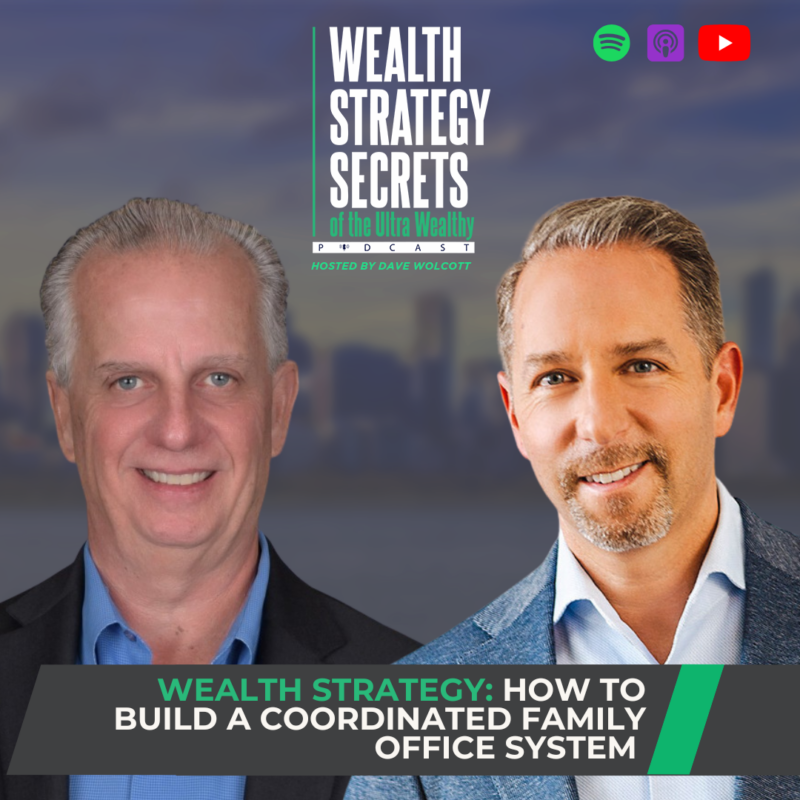
In this episode, Dave Wolcott sits down with Mike Alexander, Pantheon’s Chief Investment Officer and Head of Family Office, to explore how successful entrepreneurs can move from a fragmented collection of assets and strategies to a coordinated, end-to-end wealth system. Mike shares how Pantheon’s Wealth Assessment, the 5 Ps, and the CORE methodology can help uncover concentration risk, liquidity gaps, tax drag, passive-income needs, and other sources of hidden wealth friction.
In This Episode
- Why successful investors can accumulate significant assets yet still lack coordination, liquidity, and a clear passive-income strategy
- How the 5 Ps—Purpose, People, Portfolio, Performance, and Permanence— can reveal gaps across your financial life
- How the CORE framework—Constitution, Orchestration, Reporting, and Execution—turns disconnected strategies into a coordinated wealth system\
Mike Alexander is Pantheon’s Chief Investment Officer and Head of Family Office, bringing more than 25 years of experience working with family offices and sophisticated investors. His expertise spans private equity, private credit, real estate, energy, hedge funds, and other alternative investments.
One of the biggest challenges for successful entrepreneurs isn’t necessarily creating wealth—it’s turning that wealth into a system capable of supporting their long-term goals. Mike explains that many investors arrive with substantial portfolios but don’t know exactly why they own each investment, how much concentration or illiquidity they have, or how the portfolio will eventually produce the passive income they need.
This episode covers family office investing, wealth strategy, alternative investments, portfolio allocation, passive income, investment policy statements, wealth management, portfolio diversification, tax strategy, liquidity management, risk management, advisor coordination, estate planning, generational wealth, accredited investors, the endowment model, and building a coordinated wealth system.
The alternative investment ideas we’re bringing to clients are in that low-teens, 12% to 14% type of return target we’re shooting for, and that gives them that extra optimization in terms of income.
What if the greatest threat to your wealth isn’t a lack of assets, but the hidden friction between your investments, taxes, estate plan, insurance, and advisors? Today I’m joined by Mike Alexander, Pantheon’s Chief Investment Officer and Head of Family Office. Mike brings more than 25 years of experience advising family offices and sophisticated investors across private equity, private credit, real estate, energy, hedge funds, and other alternative assets. In this episode, Mike reveals why even highly successful entrepreneurs can still feel uncertain about their financial future, and how to transform a fragmented collection of assets and strategies into one coordinated, end-to-end wealth system. We’ll explore how Pantheon’s Wealth Blueprint assessment uncovers concentration risk, liquidity gaps, tax drag, and missed opportunities, and how the P5 and CORE methodologies create greater clarity, coordination, and execution across your entire financial life. If your wealth has grown but doesn’t yet feel fully optimized, or you’re unsure whether all the pieces are working together, this conversation will help you identify what may be holding you back and what to do next. Mike, welcome to the show.
Thanks, Dave.
Great to have you as a guest today. We’re going to talk about how you work directly with clients to help them move from owning a collection of investments, entities, and financial strategies, to having one end-to-end, integrated wealth plan and system. We’ll cover some of the areas that create hidden friction in people’s wealth, things they may not have fully understood or seen, and the fact that even as people’s wealth grows, it doesn’t always feel like they’re getting closer to freedom, because of that friction. So let’s talk about that coordinated, end-to-end system. Mike, what patterns have you been seeing with the successful entrepreneurs you’re working with?
Great question, and thanks for having me on, Dave. There are several patterns we see with clients who come through the wealth assessment review. Almost everyone has this idea that they want to retire within a couple of years and need some passive income number to live off of, and yet they don’t know how to actually generate that income. They don’t fully understand what’s in their investment portfolio currently, or how to get at that portfolio to uncover ways to generate passive income. That’s one pattern.
Another is that just about everybody we interview comes in working with different advisors: a CPA, a financial advisor, a trust attorney, probably an insurance specialist too. And yet none of those parties communicate with each other. There’s nobody coordinating the financial advisor’s investment recommendations with the tax specialist, to make sure they’re not creating an unnecessary tax burden, or making sure the tax professional who wants to implement certain strategies that might create illiquidity down the road is talking to the financial advisor. So those are some of the more common patterns: not having one central person in the middle, coordinating with all the different parties involved.
Got it. Why do you think someone can be financially successful but still feel this sense of uncertainty or disorganization with their overall financial picture?
Because most people just have a collection of investments, and if you asked them why they made a particular investment, they’d say something like, “A friend of mine told me it was a good idea.” Most people don’t really understand what they have in their portfolio. They don’t know if they’re too concentrated in one area, or too illiquid in another. They’ve been focused on building wealth over their careers, and for the most part, they’ve done a good job of that. But now they’re at a point where they need to start looking at the portfolio and thinking about re-engineering it to work more efficiently for them, in addition to having a centralized, coordinated person working with the other advisors involved in their complete financial picture.
How is this different from traditional financial planning? If a client already has a financial planner and feels like that’s how they’ve been managing their wealth, what’s the real difference between what you’re describing and that?
The first big difference is that a traditional financial planner usually has two or three models they use for clients, growth, conservative, or something in between, to build a typical 60/40 portfolio. We don’t come close to doing anything like that. In fact, we discourage too much exposure to the public markets. As I tell my clients, we govern by an endowment model, which basically means your portfolio should have somewhere between 65% and 75% of assets in alternative investments rather than the public markets. That’s a huge difference from what traditional advisors do. The other big difference is that a traditional advisor typically gets paid based on assets under management, a fee-based model. That’s not how we do it at Pantheon; it’s completely different.
So you can advise on real estate assets, alternatives, syndications, hedge funds, different kinds of exposure across the board?
Absolutely. I’ve spent the last 25 years doing exactly that for family offices, Dave. I’ve focused only on the alternative space: private equity, private credit, real estate, energy, hedge funds, all of those asset types. That’s what I’ve focused on my entire career, and it’s what we focus on at Pantheon.
Let’s get into some specifics. If someone starts working within this centralized model and an endowment approach instead of a traditional plan, what kind of portfolio optimization have you seen people achieve compared to the traditional route?
The first thing I do when I sit down with a client is rip apart their balance sheet: what assets do they have, what are their liabilities. From there, I build an investment policy statement, which really drives everything for that person in terms of asset allocation, tax strategy, insurance, and estate planning; all of that gets baked into the IPS.
But to go back to your original question, in terms of optimization, most people want some kind of income engine built for them before they move into growth. A typical portfolio I see has everything sitting in growth assets with nothing generating income, even though the client wants to retire in a couple of years. So from an optimization perspective, I start by reallocating existing, liquid assets into that income engine first, since that’s what’s going to supply the passive income they want to retire on in the next couple of years.
The other thing that gets optimized is the tax side. As I’m recommending passive income investment ideas, I’m also looking at where we can bring in a tax strategy to offset or lessen the tax impact of those new investments. I work with clients’ existing CPAs, including some you’ve recommended to clients, Dave, and we build a cohesive plan so the tax side helps cushion the income optimization coming from the changes we make to the portfolio.
Your wealth can be growing, but that doesn’t always mean you’re getting closer to freedom.
So you’d see a lift in the portfolio’s overall optimization from both the new asset allocation and from reducing that tax drag?
Exactly. Most of the baseline portfolios I look at are returning somewhere between 6% and 8% on average, whereas the alternative investment ideas we’re bringing to clients are in that low-teens, 12% to 14% return range we’re targeting. That gives them that extra optimization in terms of income.
And from a risk management perspective, what does this approach do?
From a risk perspective, I look at several things. One, going back to what I mentioned earlier, is concentration within the portfolio: is there too much exposure to a single asset class? I had a client a month ago come in with 80% of their portfolio in real estate.
Another risk factor is illiquidity. People want to make changes to their portfolio but can’t, because there’s no liquidity available. They’ve made investments they thought had a five-to-seven-year term, but if you read the fine print, a lot of these syndications and funds have the option to extend the term by a year or two. So what you thought was a seven- or eight-year deal turns into a ten-year deal, because it simply can’t be sold within the original timeframe.
So you have concentration, illiquidity, and market exposure. Our goal is to reduce as much market beta as possible in an individual’s portfolio. You don’t want the market down 20% and your portfolio down 20% right along with it. Ideally, if the market’s down 20%, your portfolio might only be down 5%, because I’ve lowered exposure to public equities as part of the investment policy statement. All of that, taken together, is used as a risk management tool.
Mike, what is the wealth assessment designed to reveal?
Stepping back, the wealth assessment is really there to reveal quite a few things, and we build it around what we call the five Ps: purpose, people, portfolio, performance, and permanence.
Starting with purpose: the assessment is there to identify exactly what the client’s purpose is; why they’re pursuing this, and where they are in their life that’s prompting them to take a closer look at their financial picture. With people, most clients come in and the assessment helps show where there are gaps in having the right team in place. Someone might come in with just a CPA and nothing else, and the assessment will point out that, in addition to a CPA, they should probably also have an insurance specialist look at their insurance needs, and someone handling estate planning.
The portfolio piece is what I’ve been describing: reviewing the portfolio at a high level to check for too much concentration, or not enough exposure to certain assets, from a risk management standpoint. Performance means making sure you’re meeting the right KPIs: if you’re expecting a 10% return across your investments, are you actually meeting that objective? The assessment checks whether you have the right tools in place to evaluate that. And finally, permanence: you want someone handling estate planning so the assets being built now aren’t just built for today, but structured to be passed on to the next generation, your family, and so on. Those are the five Ps we work through in the assessment, reviewing each one to identify where there might be an issue, or something missing.
Can you break down the wealth efficiency score and what it’s made up of?
The wealth efficiency score looks at a lot of those same Ps. It looks at your income and how you’ve done there. It scores on a scale from 0 to 100, and we like to see people above a 60. Most people are above 60, but they’re typically lacking in another area, tax strategy, estate planning, portfolio concentration, that kind of thing. It breaks down and rates each of those areas for every client who fills out the wealth assessment input form, and that’s the foundation we build everything else on.
Do you also provide any kind of stress testing?
We do. We ask the client what assets they’re invested in, so we have a high-level view of what they own. Since almost everyone has some public market exposure, the first thing we look at is what happens in a down-20%-market scenario: what’s the impact on your portfolio? If you’re a high W-2 wage earner, what happens if there’s a disruption to that income, and what does that do to your plan to retire in two years? If you’re heavily invested in real estate, what’s the impact of rising rates, or of an interruption to your distribution schedule if you’re relying on income from those investments? Things like that get stress tested.
Have you seen anything like that in traditional financial planning?
No. Some financial advisors will stress test a down-20%-or-30%-market scenario, or if you have a typical 60/40 portfolio, they might analyze the impact of rising yields on the 10- and 30-year Treasury, but nothing like what we do.
Got it. You mentioned the P5 methodology, and also the CORE methodology. Can you explain what that consists of?
CORE is an acronym for Constitution, Orchestration, Reporting, and Execution. The “C” is for Constitution, which is really your investment policy statement, what you’ve often referred to as someone’s financial constitution, Dave. It’s the wealth or financial blueprint we develop for every client, and it governs everything going forward, as long as they’re invested in assets. It covers not just investments, but also tax, estate planning, and insurance.
The “O” is orchestration: making sure you have the right people in place and actually implementing the constitution, making sure what we say we’re going to do gets done within whatever 30-, 60-, 90-, or 120-day timeframe we’ve laid out.
Reporting ties back to the performance piece from the five Ps: making sure you have a centralized system where all of your assets and liabilities live, so you can get real-time information on your entire financial picture whenever you need it, not just your investments. That’s where we bring in our Wealth OS system, which handles that reporting and performance tracking.
And execution, the “E,” is on me: making sure everything gets done the way we’ve mapped it out according to the constitution. One thing I do is build a cash flow map for clients working to get from point A to point B over time, and then make sure it gets executed properly.
Within the virtual family office, how is it structured to meet people where they are and how they want to engage, and how is that different from what you’ve seen traditionally in the market from other financial advisory firms?
We’re structured around several tiers. Gold is the baseline package: I build the constitution, the IPS, along with a mapping plan if needed, plus an asset allocation review to make sure changes get made based on the investment policy statement, and quarterly check-ins to make sure things are moving according to plan.
The next level up is Elite, which includes everything in Gold, plus more of my time, more frequent check-ins than quarterly, and I’ll also review and conduct due diligence on other investment ideas the client wants me to evaluate. Someone recently brought me an energy tax credit idea, for example, and I’ve been doing due diligence on that and reporting back with my thoughts. Elite also includes access to our mastermind group at Pantheon, a great group of around 30 members that meets twice a month.
The highest level is Platinum, for people with more extensive or complex portfolios. I have one client with 60 different investments who’s considering Platinum; he wants me to go through and conduct due diligence on all 60 to make sure he understands what each one is doing and its purpose. At that level, think of me as essentially the client’s outsourced chief investment officer, available whenever they need me.
As for your other question, I’ve genuinely never seen anything like this in the market. Most firms offer a flat, retainer- or fee-based model with maybe semiannual or quarterly portfolio reviews. You’re not getting much time, and you’re not getting real coordination with the other players a client is dealing with, tax strategists, insurance, estate planning. Traditional firms don’t quarterback or coordinate information flow across those other advisors the way we do.
You need to know where you are today before you can map where you want to go.
How should people think about which tier is right for them, based on where they are in their journey?
That’s a great question. Once we go through the wealth assessment with a client, it’s usually pretty clear what they need. It tends to fall out naturally from that analysis.
Can you give us some examples, Mike, to make this concrete, how people can really think about the value here, since it’s fairly unique in the marketplace, and sometimes you don’t know what you don’t know?
Sure. A couple of examples come to mind. One was a client heavily invested in real estate who hired Pantheon to help diversify their portfolio. They wanted to slowly move away from real estate and build that income engine, and they were gung-ho about it. As we were building out the investment policy statement and I was showing them a cash flow map, I stopped and asked if they’d thought about setting up an Infinite Banking Concept, or IBC. They said they’d thought about it, but not seriously. I told them, given how many kids they have, it would be worth talking to our insurance specialist, funding an IBC, and using it for multiple benefits: a death benefit, asset protection, and the ability to borrow against the policy and reinvest that money into other investments, building out that passive income engine. That was the aha moment for them. They ended up working with our specialist, set up the policy, borrowed against it, got access to the money within a couple of weeks, and I’ve already invested a good chunk of it for them into other opportunities they’re happy with.
The other example is a client who’s done a great job building a business and a tremendous amount of wealth, but almost all of it was tied up in that business. He came to us looking for ways to diversify and build an investable portfolio, as well as something he could eventually pass down to his children. I’ve been working with him on a three-year roadmap to start selling small pieces of the business to interested private parties, rather than selling the whole thing at once, in amounts small enough to be manageable but large enough to generate significant cash flow to reinvest and build out his investment portfolio. That’s moving along nicely too.
So you’re essentially helping build one entire end-to-end wealth system across the full spectrum, tax, portfolio allocation, risk management, estate planning, all of it. And on the advisor coordination side, has that reduced friction led to more clarity and better decision-making as well?
All of the above. I can point to multiple examples where I’ve been looped into calls with a client’s tax strategist, so the client, the strategist, and I are all working together and on the same page. I actually just got off a call before this one with a client and their tax strategist, going over what we need to put in place before year-end. Here we are on September 3rd, and we already need to start getting things in place this month to hit the 2026 year-end deadlines. There’s a lot going on, and it’s working well.
What would you say the ROI looks like from going through that process?
For one, it saves the client time, which matters a lot to them, and it saves them from having to spend that time researching different strategies themselves. It also frees them up to focus on other areas. I have one client I’ve been helping with tax planning, which has freed him up to focus on estate planning, since we need to get to that too. Beyond that, we’re starting to see real return benefits from the optimized portfolio itself, which has been a big part of the ROI. And with the rollout of WealthOS, clients now have a system that saves them an enormous amount of time and gives them real clarity on their KPIs, which has been great as well.
If someone’s on the fence about this, thinking they’ll wait and revisit it next year, what’s the impact of waiting versus acting now?
There’s this wealth friction tax you mentioned earlier: a lot of hidden friction costs brewing under the surface that people don’t see. It could be a liquidity issue they haven’t really thought about, or something related to the time they actually need to retire. You really want to look at these things now rather than later, because they tend to fester and get worse the longer you wait. I’d recommend anyone take the wealth assessment now, even if you don’t think you’re ready. You might be surprised by what you find.
Any final thoughts you’d like to share, Mike?
Overall, Dave, you and I are here to help people, and that’s really one of the reasons I joined Pantheon: to help as many people as we can meet their financial goals. We’ve seen great success from clients who’ve gone through the wealth assessment, changes they’d never even considered that we’ve been able to introduce them to. The goal is simply to help people meet their financial goals, and I think we’re doing a good job of that.
Do you have any contact info for people who’d like to reach out with questions?
You can always email me at mike@pantheoninvest.com; that’s the best way to reach me. My contact information is also on our website, pantheoninvest.com, or there’s an IR link there where someone can get your information over to me.
Mike, thanks so much for your insights today. Really a pleasure having you on. Hopefully this has opened up some new thinking for listeners in terms of how they’re approaching their wealth, and helped surface some of these things that are happening beneath the surface but hadn’t been easy to pin down. Thanks again, Mike, appreciate it.
Anytime, Dave. Thanks.
I hope you found today’s episode valuable. If you recognized yourself in this conversation, especially if you’ve accumulated investments, entities, advisors, and strategies but don’t feel everything is working together, the next step is to complete the Pantheon Wealth Assessment. This isn’t about finding another financial product; it’s an opportunity to evaluate your entire wealth system and identify where friction, risk, or missed opportunities may exist. Go to holisticwealthstrategy.com/wealthblueprint. And if you’re not ready for the assessment yet but want to explore these ideas further, check out the masterclass at contrarianwealthbuilder.com.