
Listen Here



The biggest investment mistakes aren’t caused by bad markets—they’re caused by bad thinking.
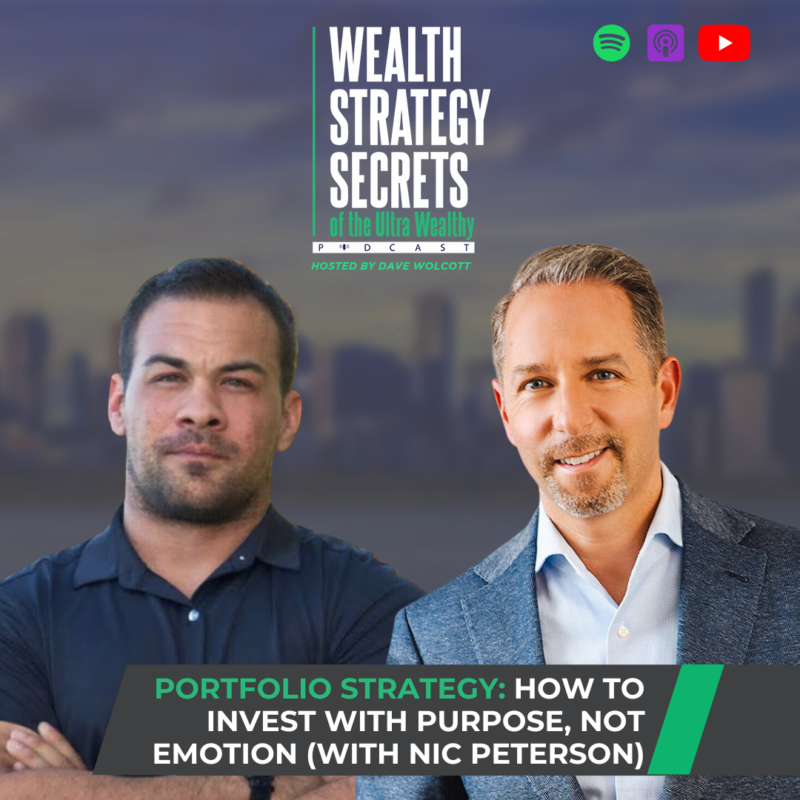
In this episode, Dave Wolcott sits down with entrepreneur, investor, and  Bumpers author Nic Peterson to explore the hidden psychology behind investing and wealth creation. Together, they unpack why so many investors chase the latest opportunity, confuse activity with progress, and allow emotions to override even the best financial plans. Instead of focusing on predicting markets, Nic shares a systems-based approach that helps investors avoid costly mistakes, allocate capital more intentionally, and increase the probability of achieving their long-term goals.
The conversation also explores portfolio construction, risk management, crypto investing, probability-based decision making, and why the best wealth strategies begin with defining what you’re actually trying to achieve. If you’re looking to build wealth with greater clarity and discipline, this episode offers a refreshing framework for thinking differently about investing.
In This Episode
- Why psychology—not investment knowledge—is often the biggest determinant of investing success
- How to build a portfolio around your life goals instead of chasing returns
- A practical framework for balancing certainty, opportunity, and long-term wealth creation
Nic Peterson is an entrepreneur, investor, systems thinker, and author of Bumpers. After building and exiting multiple businesses—including a $56 million business sale—he now operates a diverse portfolio of companies while helping entrepreneurs and investors identify the recurring patterns that drive long-term success across industries.
This episode covers wealth strategy, investing psychology, portfolio management, asset allocation, behavioral finance, crypto investing, Bitcoin, Ethereum, blockchain, risk management, probability-based investing, alternative investments, entrepreneurship, passive income, financial freedom, and long-term wealth creation.
Nick, welcome to the show.
Yeah, man, I’m glad to be here. This will be fun.
Yeah, you bet. Super excited to have you on the show, Nick. I know you’re really going to have people thinking about their thinking by the time they finish this episode and really seeing things in a different light. That was one of the first things when I had first heard you talk that I felt was so parallel and really intriguing—just the way you’re actually thinking about wealth, the way you’re thinking about value creation and what’s really important. I think too many people just get really caught up in chasing a shiny object, or they heard about this investment, or they heard about the latest in crypto from their buddies and think, “Hey, I’ve got to get in this.” Fear of missing out makes them want to jump in, whatever the asset class is. It’s just all the psychology of it.
I read your book, Bumpers, which I think is a really fascinating way to look at it. I know you have a lot of strengths around really systematizing businesses as well, and then how that really applies to investing and the theory of constraints. Why don’t we start to unpack some of those? Just to level set for folks who don’t know who Nick Peterson is, or haven’t heard of Wolfden or maybe one of your other businesses, you could tell us a little bit about how you got here.
Man, that is quite the story. I haven’t practiced—I don’t have the Brendan Burchard trauma story dialed in yet. But currently, just a little bit of background, I have a portfolio with nine companies in it, and four of them I own and operate. They are all in different domains and different industries. The way that I ended up getting here is I have an operating system—which you are familiar with if you read Bumpers, the base of that operating system—and realized years ago that there’s nothing new under the sun. It’s like the same stuff over and over.
When you get into these different worlds—I started in fitness with a gym, then got into a nutrition company, and then I had a third business coaching other people how to do what we did, which sold for $56 million. All of these people came from all these other worlds. I used to have a client who was a farmer from North Dakota who said, “Hey, I have a farm. Can you help me?” I said, “I don’t think so, because I’ve never had a farm.” But as we were talking, the language was different, but you realize these are the same patterns. You have a different language for it, but these are the same things.
Most of the time, it’s less about knowing the technical details. If you talk to investors, whatever they invest in, whatever the criteria is, whatever the technical details are, people get lost in all that. There’s another side of that, and that’s the human doing the investing. I call it the adaptive dilemma where you can have all the best theories in the world, but if your amygdala gets hijacked and you make impulsive decisions, then the plan doesn’t really matter because you’re not following it anyway.
I started developing this in fitness, realizing that people have a plan and then there’s what they do, and they are two different things. They are, most of the time, completely unaware of the gap between what they plan to do and what they actually do. They do whatever they do, and they’re not aware of the gap between what they did versus what they were supposed to do. So whatever the outcome is, they think that’s a byproduct of the plan. They’re gauging the efficacy of the plan based on the outcome, which is nonsensical because you didn’t do the plan. You followed it like 70% or 72%.
I was just observing that we all engage with business, fitness, investing, and our families, and we have these plans and these feedback loops where we say, “Okay, I tried this and this is what happened.” It’s just recognizing that you didn’t try this. This is what happened, but you didn’t try what you wrote down and planned on doing; you did something different. Until you recognize that, your feedback loops, especially in terms of getting what you want, are going to be broken.
I took that from fitness and went into business. I started a mastermind, and my rule was—since I didn’t want a mastermind and just had a line of people ready to pay for it—no two people in the same industry doing the same thing. I didn’t need the money and I get bored easily, so I wanted to see across all these different domains how many patterns and principles we could identify that cross over. It was $36,000 a year, and in the first month, I had 44 people who did 44 different things. I did that for two years, and I spent all day, every day—just because I was fascinated with everything going on—identifying these patterns that show up over and over, regardless of what domain you’re in, what you’re selling, or what you’re investing in.
Through that, the ones with the most alignment out of those 44 people, I started pulling partnerships and partnering with them. That’s where most of my companies come from now. You say, “Hey, I want as many diverse, different people as possible,” coach them, and then I just kind of wound down the coaching and focused on the handful that I think are doing something really cool, interesting, and impactful. That’s what Bumpers, R3, and everything that I write about is fundamentally. I’m mostly only concerned with the repeating patterns. I don’t get super deep into, say, medicine—there are things that apply to medicine and only medicine, and that’s not me. I’m not a doctor; I don’t need to know all that stuff. But those experts do tend to miss the fundamental recurring patterns, and that is where I think I am the most helpful or useful to them.
Yeah, really fascinating. So would you say all those patterns are really encapsulated in your book, Bumpers? Would that be the essence of it?
No, but if we talk about highest return, I think those are the highest-leverage, most common patterns. In Bumpers, you have “appreciate when bad things don’t happen,” “raise the floor,” and “you can’t win a race you don’t want to be in.” Those are the first steps. If you want to get from A to B, it’s really helpful to not get blown up or step on a landmine, and it’s really helpful to actually go in the correct direction. Those are the two things: if you can just avoid dying and keep pointed in the right direction—and you’re the kind of person that’s probably listening to this podcast, a driven person—those two things are enough. Just don’t go the wrong direction or kill yourself.
Yeah. So why don’t we just unpack that a little bit more for the listeners? If people haven’t read the book yet, let’s get into a little more detail in Bumpers about not killing yourself. It’s a really interesting concept, and I was contemplating that in relation to other theories that are out there, like Yin and Yang, where there are so many versions of reaching peaks and then having lows, and that’s just life and managing that. Tell us a little bit about Bumpers.
Yeah, I love that you mentioned Yin and Yang theory, because I have a grandmaster and I have to study all five phases. So, Bumpers—one of the recurring patterns I saw first in fitness, and I’m really grateful for. For a while, I was embarrassed about being a fitness professional because they don’t always have the best reputation. But I’m so grateful that I learned everything I learned in the context of biology, because it’s a complex, adaptive system. If you can learn through the lens of biology, complex systems start to make more sense—things like emergent properties, etc.
Watching these gym-goers, who were my clients at first, you recognize—and I’m a resource allocation guy. I learned really, really young when I went pro in Strongman and my coach gave me this whole spiel about how important it is to conserve energy, and it really stuck with me. From a resource allocation standpoint, the number of people that yo-yo diet—they gain 30 pounds, they lose 30 pounds, they gain 30 pounds, they lose 30 pounds. You see the tremendous amount of resources that go into losing that 30 pounds each time: a significant amount of time, effort, bandwidth, and money. From a resource allocation standpoint, it was like, “What is going on?” Because if you could put all of that effort you’ve put into losing the same 30 pounds over and over into making progress, you would be so much further along and in a much better place.
That’s the pattern we kept seeing. Okay, so you had a million-dollar month, and then you had two months where you lost a million dollars, and then you had a million-dollar month. Well, if you could just avoid the losses—or in the first case, if you just avoid the weight gain in the first place—you can recapture all that time, effort, money, and resources, and put it into inching forward and making progress. So why aren’t you doing that?
My observation, and I talk about this quite a bit, is if you have a family member who is pre-diabetic and has struggled with their body weight for some amount of time, and they lose 30 pounds, what happens? They celebrate, you celebrate, everybody celebrates. It’s a massive dopamine hit. But let’s say your sister never gained the weight to begin with—nobody’s celebrating her. There’s no dopamine for avoiding bad stuff.
What our brains learn over time is: “If I want a dopamine hit, I can just dig a hole for myself and dig myself out. Free dopamine!” Whereas making progress is hard and painful, and there are not a lot of immediate rewards. A lot of people get stuck in this loop. It’s like the entrepreneur who shows up at the office and starts a bunch of fires just so they can put them out and go home feeling like a superhero firefighter.
I just see this pattern over and over, which is why I wrote Bumpers, which is saying, “Hey, can we appreciate—I understand why we celebrate getting out of a bad situation, but that’s still not ideal because you were in a bad situation, you lost time, you lost money, and you probably damaged relationships. Can we celebrate, or rewire our brains to at least appreciate, when a bad thing doesn’t happen?”
That was most of it. We had people come in for coaching and the mastermind, and they would start making progress in leaps and bounds. Everybody came in through referral asking, “What’s the magic? What is Nick doing? What secret tip or trick does he know that nobody else knows?” And it was, “Yeah, let’s just go back, identify all the bad things that happened, and then figure out how to avoid them in the future.” That’s the secret sauce.
Bumpers is that foundational concept. You know how many entrepreneurs, investors, and people in general look at crypto, AI, and high-upside assets because, on some level, they’re trying to push harder on the gas to get to wherever they’re going faster. I get it, but maybe we should take our foot off the brake first. That’s what Bumpers is: just take the brake off, then push on the gas. It’s been surprising to me; I wrote it six years ago and it just gets more and more popular, so hopefully people are starting to appreciate or at least think about avoiding bad things.
Yeah, I totally love that, Nick. I really recognize that pattern in investing. In 2000, I took a complete bloodbath when the tech bubble happened. The market just blew up, and since I was in the tech industry, I was heavily invested in it and believed in it. But I really recognize this pattern that I think a lot of people don’t see on the equity side of the equation, which is that one of the biggest wealth destroyers is actually stock market losses over time.
Everyone thinks, “Hey, last year I did 15%, it was great. The year before it was 18%. We were up 12%. We’re doing great.” They get that statement and everything is good, but they forget that in 2008, when the market was down 30%, that takes your compounded number and brings it all the way down. What you have to do just to get back to where you were takes an enormous effort. That ties exactly to your metaphor of losing weight—it’s the exact same thing with investing. It’s all the psychology of it, but people lose every time.
Yeah, and like I said, it’s the same stuff over and over. The interesting thing about investing, from my perspective—and I deal with quite a few very intelligent investors who struggle with this concept—is risks and probabilities. There are no certainties; it’s always risks and probabilities that we’re processing when we’re investing.
Okay, you got 18%. Does that fund your life goals? No? Well, then it doesn’t really matter, because the purpose of all of this is to fund something, I assume. Our operating methodology is that we actually figure out what we’re trying to fund and on what timeline we want to fund it, turning it into a multivariable equation.
This is totally going off-script—this is not what we were going to talk about—but since investing came up, this is how we think about appreciating when bad things don’t happen in regards to investing. I’ll give you an example: somebody asked me, “Where should I put my money?” We had just saved her $130,000 a year by going through a process of recapture and reallocation. She has done really well, so we found $130,000 a year.
I asked her, “What is the most important thing to you? Because all I care about is that you get what you want; I don’t care about anything else.” She said, “The most important thing is my son is going to college in four years. I want him to go to Switzerland, I want to be able to pay for it, and I would love to stay with him. I don’t care how much it costs, but I need an extra $400,000 above what I have in the account right now.”
I said, “Cool. We just saved you $130,000 a year. Over four years, you’re already there. You just take that money you saved, put it in the account, and the most important thing to you is locked in with a 100% probability.” And she said, “Okay.”
Five minutes later, she asked, “Where should I put that money?”
I said, “In the bank account. You should put that money there because it represents something that is important to you.”
She said, “Well, I was thinking about real estate. What do you think about that?”
I said, “What is the probability that if you take that extra $400,000 and put it in real estate, you get what you want? The probability has gone down. Now, that real estate might 10X in 10 years, and that’s really tempting because it’s more money and a bigger opportunity. However, the probability that you get all of that money out in profit in four years is relatively low, so you’re actually putting the important thing at risk by trying to make more.”
That’s the whole game of how we appreciate when bad things don’t happen: what is the most important thing, and how do we fund it as soon as possible? If you want to fund it in two years, don’t put that money somewhere that is going to take more than two years to mature. It might make more, but you’ve decreased the probability that you get what you want. Don’t do things that lower the probability of getting what you want.
Yeah, that is so spot on, Nick. In my book, The Holistic Wealth Strategy, that’s exactly what we talk about: creating that vision for yourself first before you look at any investing, no matter what your numbers are. It’s getting crystal-clear clarity on your freedom of purpose, your freedom of time, your freedom of money, and what you are looking to do, because everyone has something different. But I love how you frame that in terms of certainty and probability. Do you have some type of model that breaks that down further, like an asset allocation model to morph that into?
Yeah, we do. It starts with what we used to call the “solvable problem.” They still call it that, but I sold that company and it’s trademarked, so I don’t use the term anymore. It’s really getting clear on your number-one priority. Okay, your number-one priority is that you want to pay off your mortgage; you just want that done, and that’s the most important thing. Cool—how much is that, and what is the timeline? Now we have a problem that we can solve for.
Here is the high-level overview: we look at where you are at and where you want to be, and we only deal with one priority at a time. I’ll explain why this is my preference—and I’m not a financial advisor, so all those disclaimers apply. I fund one priority at a time in the order that I prioritize it. If you have three priorities and say, “Okay, I’m going to put a third of my money here, a third of my money here, and a third of my money here, and in nine years I’ll fund everything,” in a vacuum, that might work. However, let’s say four years or three years in, a crisis hits. Now you are up a creek without a paddle, and you have three things partially funded with no path forward. Had we funded the number-one priority entirely and a crisis hit, you would still be up a creek, but at least you got the most important thing to you taken care of. We waterfall it.
The way we do that is by defining the number-one priority. My brain says you can have it all, but let’s assume that time is going to pass and randomness exists. If you could only have one, what would the most important thing be? That is number one. That is always hard, because nobody ever wants to admit what the most important thing actually is—but that’s a whole different story.
Then we say, “Okay, given where you are at and what you make, let’s flip the math on its head.” If I am here, and I want to be there in four years, and that is my number-one priority, given where I am today, I need an 11% return a year. That tells me the kind of risk profile you should be playing with. If you need 11% a year and you say, “I’m going to go to crypto,” I’m going to tell you that you don’t need to take that kind of risk to get 11% a year. If you need 3% a year, cool, maybe bonds or the S&P.
So, I need 11%. Let’s say I go into an investment that I think will get 11% a year, and it overperforms and does 17% in the first year. We would take that 6% overage and either take it off the table or flip it into something less volatile and less risky. This is hard, because everybody wants as much as possible, but we are playing the game of increasing probability, not the game of getting as much as possible.
You do the same thing if you have a goal and realize you are going to need a 37% return a year to fund it. First, can we increase your income? Can we find another way to make that number smaller? But let’s say you absolutely need 37% a year—you are going to have to take more risks. I don’t consider it risky in that context, because the biggest risk is that if you need 37% and you put your money into something that gets 8%, you are guaranteeing you don’t get what you want; you have driven the probability down to zero. The way we process risk depends on what you need to get what you want. If you need 37% and all your money is sitting in something that gets you 6%, that is the riskiest thing you could do, because you are guaranteeing you don’t get the most important thing to you.
So our model is: can we figure out what kind of return we need to lock in the most important thing? That informs the timeline and what options we have. If you need 7%, you have all kinds of options. If you need 2%, I would wipe most of those options off the table because they are too risky. If you need 45%, you wipe all the safe stuff off because you have to try for 45%.
We take the overage, and there are three things we can do with it. I’m very simple, not a complex guy: take it off the table and put it under your pillow if you want, flip it into something less risky like bonds, or use that 6% overage to take big bets with “house money” to collapse the timeline down. Do that with the first priority, and once the first priority is funded, roll it down to the second and the third, and systematically try to lock in the things that are the most important to you with the appropriate amount of risk. This is totally relative to where you are at and what is important to you.
Yeah, it’s such a top-down approach that is very strategically thought out. A majority of investors come bottom-up because they’re just looking at the specific investment itself and thinking, “I’ve got to be in this or that,” because of whatever is driving them, or because their amygdala is saying, “I just need more; that one sounds better.” But this is so purpose-based.
We think of it as a pyramid. At the base level, you have your lowest amount of risk and the most amount of certainty. As you move to the top of the pyramid, you have your highest amount of risk, which is really speculation. That’s where I see crypto sitting, or angel investing in businesses, because you have no control over that.
Let me ask you, Nick: what is your Kolbe score? Do you know your Kolbe score off the top of your head?
It’s funny, because Justin Breen is upstairs in my office right now, and he is a freak about Kolbe scores. I’ve sent him mine, but I don’t remember the exact order. I am an 8 Quick Start, a 7 Implementer, and my Follow Through and Fact Finder scores are low.
Interesting. I would have guessed that you were a high Follow Through because of the way you systematize your businesses and how you’ve picked up on all these patterns. I’m a 7 Follow Through. If any of the listeners haven’t taken it, I highly recommend going to Kolbe.com. It’s a 20-minute test and it unpacks your instinctive nature on how you are wired. It applies to investing, entrepreneurship, and so much else. I was in the tech industry doing a lot of process consulting, and understanding this explains exactly why I’ve been trying to systematize wealth-building for so long. It’s a process. If you get on the scale and you’re trying to lose weight and you are just chasing that number, it’s completely volatile. But if you focus on the process and have your purpose aligned, you’re much more likely to achieve the results.
Yeah, I agree. I tell people all the time that if you followed me around day-to-day, I would look like I have high follow-through, but it’s because I know that I don’t. I have to actually engineer systems. I’m an implementer, so I have to touch stuff. I engineer systems to put problems in front of me so I can’t help but do something about it. I piggyback off my Quick Start nature to engineer follow-through. I build a system where things show up to me randomly and I think, “My God, I have to fix this.” It looks like high follow-through, but I have to systematize things that way, otherwise they will never get done.
Right. Any other systems or patterns that you’ve recognized from your businesses that you’re applying to your investing now?
Nic: Yes, the biggest one—and I built my whole portfolio this way—is a concept you can learn more about from Nassim Taleb in Antifragile and his other books. It’s the concept of the “barbell,” or a bimodal strategy. It’s Seneca’s bimodal risk mitigation strategy: on one side, you have your extremely high-upside investments or activities, and on the other side, you have your reliable ones.
People in the entrepreneur world confuse the barbell all the time. I did not say “passive”—I said “reliable,” and they are different things. Everybody goes for passive, but your upside stuff and your reliable stuff can be passive or active in either scenario. What I’m looking for on one side are things that have a tremendous amount of upside, though the mere fact that they have so much upside means we know they are not reliable. On the other side, you have reliable.
In a business context, a lot of people start a business because they think it has infinite upside, but they learn really quickly that it doesn’t. A relational business like an accounting firm doesn’t have the scale that everybody thinks it has, so it’s not an upside play. It’s also not reliable in the sense of, “Can you tell me exactly how many hours you are going to spend in the office next week, what you are going to do, and what the outcome will be?” They say, “I don’t know, I just show up.” It’s not going to function without you, and even with you, the outcomes are variable and all over the map. That sits smack-dab in the middle of the barbell, meaning it doesn’t have true upside, nor is it reliable—it’s a job.
I don’t want to be in the middle of the barbell, ever. Our human instinct pulls us to the middle because we want more certainty out of the high-upside stuff, and we want the reliable stuff to be exciting, so we keep breaking it. Our instinct keeps pulling everything to the middle, and I am actively pushing everything out. It is either an upside play or a reliable play.
In our businesses, these are either liquidation plays or cash-flowing plays. If it sits in the middle, it’s neither: it’s not reliable cash flow and it doesn’t have massive upside, so it should not exist.
I look at investing the exact same way and built my portfolio based on this strategy. A handful of my companies exist purely for reliable cash flow, and I don’t care about their enterprise value. For other companies, I don’t care about the day-to-day cash flow because their role is to provide a massive exit later.
Investing is the same. Let’s say we need 11% to reach all of our goals. What I would do is try to have things on the reliable side that have an expected value of greater than 11%. That overage, if it were me, I would flip over into investments on the other side with tremendous exit capacity. Because of probabilities and risks, if I want to get from A to B in six years and an 11% return will do that, I want the reliable side to be robust because I want certainty that, worst-case scenario, I’m going to get everything I want in six years. But if there is overperformance, or if I get a tax return or anything above that, I’m going to put it on the upside side of the barbell.
One side of the barbell gives me certainty that I’m going to get what I want, while the other side allows randomness to potentially collapse that timeline down from six years to three. One big exit and boom, you’re there. That’s how I build everything. For an investment strategy, I want the reliable side to fund everything that’s important to me in a timeline that is fair and appropriate. Worst-case scenario, if I get all this stuff in 10 years, it’s fine; it’s not ideal, but it’s fine. Then I let the randomness of the high-upside stuff—like crypto—play out. If Bitcoin goes to a million bucks, sweet—we reached our goals faster than expected. But even if that didn’t happen, we locked it in through the reliable side. It’s a bimodal strategy, and I just fight like hell to stay out of the middle. If it doesn’t have massive upside and it’s not uber-reliable, it doesn’t have a space in my portfolio.
Yeah, that’s such a great way to think about it and create that certainty. I think about the psychology of why you are making an investment. People don’t ask “Why?” and drill down until they can’t ask it anymore. Oftentimes, what you’ll find is they are actually trying to create certainty because they are in a job that might go away, or they have a child on the way and want one of the parents to be able to stay home. Creating the certainty to do that gets you there, and then you get to pick your investment vehicles and asset classes that support it.
Tell us a little bit from a crypto perspective. We don’t need to get too deep in the weeds, as we have a ton of tech investors and entrepreneurs in the community who have a good base of knowledge, but what is the state of the market and where do you see it trending?
I’ll do my best. You have crypto, and I know a lot of people who invest a lot of money into blockchain but are not buying cryptocurrencies—there is that distinction. There is the blockchain, which is the underlying tech that stores data in blocks instead of columns and rows, and then you have the assets that live on and are transferred on the blockchain, like cryptocurrencies and NFTs.
Investing in blockchain right now, if you have a long enough time horizon, is probably a really good idea. There are so many companies building on it—IBM built a blockchain, for example. If I was dabbling and didn’t want to get left behind, which is where most people are, I wouldn’t go buy crypto personally unless you are prepared for the vicissitudes of what crypto is right now. You can find really great companies like IBM, Microsoft, etc., that are building in Web3 on the blockchain, because that value will get reflected in their stock price and you don’t have to deal with all the volatility.
For those who feel like they are going to get left behind and are leaving their comfort zone to buy crypto: if you buy crypto because of FOMO and you have not experienced 70% drawdowns before, don’t buy crypto. Find a company or an ETF—something more familiar. I do think investing in companies tinkering with blockchain tech is a good move. Those are the same companies tinkering with AI, and they’re probably going to combine the two to do some really cool stuff. It won’t be as sexy or fun as Dogecoin going to a gazillion-X, but it will get reflected in their stock price and people will be happy with it.
On the crypto side, inherently there is no value to NFTs outside of their sub-utility, provenance, and royalties, so it’s totally subjective and comes down to whether you believe in the project.
Cryptocurrencies are interesting to me because a lot of people look at crypto the same way they look at investing in Apple. But when you invest in Apple, you aren’t investing purely thinking that a bunch of other people are going to buy Apple stock; there is an invisible third party. The people standing outside the Apple store to buy an iPhone are participating in the market, but they aren’t buying and selling stock. Crypto doesn’t have that third-party participant yet like equities or even commodities do. In commodities, somewhere the rice is getting delivered, cooked, and eaten. There is not really a third-party participant in crypto yet, which makes it highly speculative, and I think everybody knows that.
The other thing is that the commodities market exists for bona fide hedgers who want to stay in business, and they allow speculators to participate so there is sufficient liquidity. Equities exist so you can invest and have a piece of performing companies. Crypto is different in the sense that there is no equivalent to bona fide hedgers, and not all crypto assets are designed to be investments—sometimes they are the utility itself.
I think that’s why most people get wrecked, for lack of a better term: they just look for assets that are going up or down. But unlike any other market, each of these crypto assets has a different utility within an ecosystem that they probably don’t understand. If you get into crypto, the easiest thing is to study Bitcoin. It’s been studied for 13 years, people understand it, and people like Elon Musk and Michael Saylor buy it. You can also learn a lot about Ethereum, as it’s mostly publicly available. But anything smaller than that, if you don’t understand the utility of it, I’m not sure it’s a great idea to buy it.
Yeah, that makes sense. Do you think it’s too late to get into the game, or if someone is not technically inclined to go deep into this asset class but wants exposure, are there any general thoughts around Bitcoin, Ether, or percentages?
Yes, I do have an opinion on this—though again, this is not financial advice. It’s kind of like talking about the dot-com bubble. I’m sure you could have made sound arguments for a lot of those companies at the time, but most of them don’t exist anymore. That’s where we are with crypto: you could look at the top 20 projects, and I’d be willing to bet only five of them still exist 10 years from now. There was a time where I would have told you there’s no way any search engine takes over Ask Jeeves, and who uses Ask Jeeves anymore? Things change so quickly.
Bitcoin is likely the safest bet, and you can deep-dive into it all you want as there is a lot of great information. In my opinion, the question is: is Bitcoin going away, yes or no? My opinion is no, it’s not going away. If it’s not going away, and there can only ever be 21 million Bitcoin—which means not even every millionaire in the U.S. could own a full Bitcoin—that alone tells me it’s probably a sound investment if you have a long enough time preference. Just know it’s going to be volatile due to regulation and other factors. Right now, Bitcoin has no utility outside of being like digital gold; it’s a slow network.
With Ethereum, almost everything in Web3—projects, Bored Ape Yacht Club, NFTs—is built on top of it. At this point in time, if any projects in crypto win, Ethereum wins. For that reason alone, I hold Ethereum and would take a bet on it. If I were going to bet on crypto, I would bet on Bitcoin and Ethereum. There is not much benefit to diversifying beyond those two if you’re just starting. The other thing you have to worry about is tracking it all. Bitcoin and Ethereum are very easy to track, but as you get into smaller-cap coins, you start losing track of how to check the price, where it’s at, and how to buy and sell it.
What’s your view on people looking at crypto as an asset class that serves as a hedge against the dollar?
That’s a great question. I am not formally trained in this—I have partners who are, but I am not, so I will use lay terms. Conceptually, I understand the hedge-against-the-dollar argument, but here is the issue I have: most people who want to have that conversation cannot formulate a good argument.
When you buy Bitcoin, how do you measure whether or not it was a good investment? By how many dollars it’s worth. You see what I’m saying? We say we want to hedge against the dollar, but then our behavior and reactions say, “I bought Bitcoin and now it’s down.” It’s like, so you wanted more U.S. dollars to hedge against the dollar? How is that different from any other investment?
Until we start measuring Bitcoin’s value in Bitcoin—”I have 0.3 Bitcoin yesterday, I still have 0.3 Bitcoin today, and 0.3 Bitcoin will get me the same amount of goods”—I don’t think anybody is actually hedging against inflation or the devaluation of the dollar. Based on my observations, they are just trying to acquire more dollars, so it’s like any other investment. It’s a hedge against a weakening dollar in the sense that you hope to end up with more dollars, but you still can’t go to Chevron and buy gas with Bitcoin. In time, it may prove to be a good hedge, but for now, that’s not how people are actually treating it.
If you hate the U.S. dollar and want to get rid of that “trash,” but then buy Bitcoin and complain that your Bitcoin is worth fewer U.S. dollars, those two beliefs don’t live well together. You either hate the dollar or you want more of it. Having beliefs and actions that are diametrically opposed makes it very hard to have a sound investment strategy.
Yeah. For the listeners out there, the data I have collected so far on ultra-high-net-worth individuals and family offices shows an average of 1% to 3% portfolio allocation into cryptocurrency, just as a data point.
Yeah, I think that’s great. And I think that will go up. When you asked if we’re late, I think we are actually still early because regulatory clarity will increase. High-net-worth individuals will invest way more once they have clarity on the legal ramifications.
Excellent. Nick, if you could give just one piece of advice to the listeners about how they could really accelerate their own wealth trajectory, what would it be?
A version of what we talked about: make a distinction between speed (going fast) and velocity (going fast in the right direction). To accelerate your path to wealth as defined by you, take time to gut-check yourself on what really matters to you. What are the most important things? That clarity will help you discern between different investment options. If you’re super clear on what matters and think in terms of what gives you the highest probability of achieving those things, it will start to inform all of your decisions.
Awesome. So many great takeaways. Really appreciate the insights, Nick. If people want to learn more about what you’re doing with Wolfden or your other companies, what’s the best place?
The best place is probably just to start with the book. If you go to bumpersbook.com, it will take you straight to Amazon. The reason I send people there is because I don’t have anything to sell them, and the book is super short. In my experience, you’ll read it and either find it self-evident and get it, or it’s just not your thing. It’s the best filter I have. If you like it, you’ll figure out how to find the rest of my stuff; if not, it’s a cool 45 minutes of your day and now you know.
I’d like to throw something else out there to the listeners to thank Nick for his time today. I noticed you have about 85 reviews on Amazon, and as I understand it, once a book crosses the 100-review threshold, the algorithm moves it up into the suggested categories. If you guys have a chance to download Bumpers and read it, please give Nick a review. If he gets just 15 more reviews, we’ll cross that threshold. I’m definitely going to do one myself.
That’s great, I didn’t know that, but thank you.
You bet, Nick. Thanks again. Really appreciate the dialogue, and I think this will help people challenge conventional thinking and think outside the box on what wealth really means, how to allocate capital, and what’s truly important.
Yeah, it was fun. I haven’t talked about investing in probably a year, so it’s good to drum up some of this stuff again.
All right, Nick, thanks again. Really appreciate it.
Likewise.