
Listen Here



Most entrepreneurs spend years learning how to build wealth—but very few learn how to protect it.
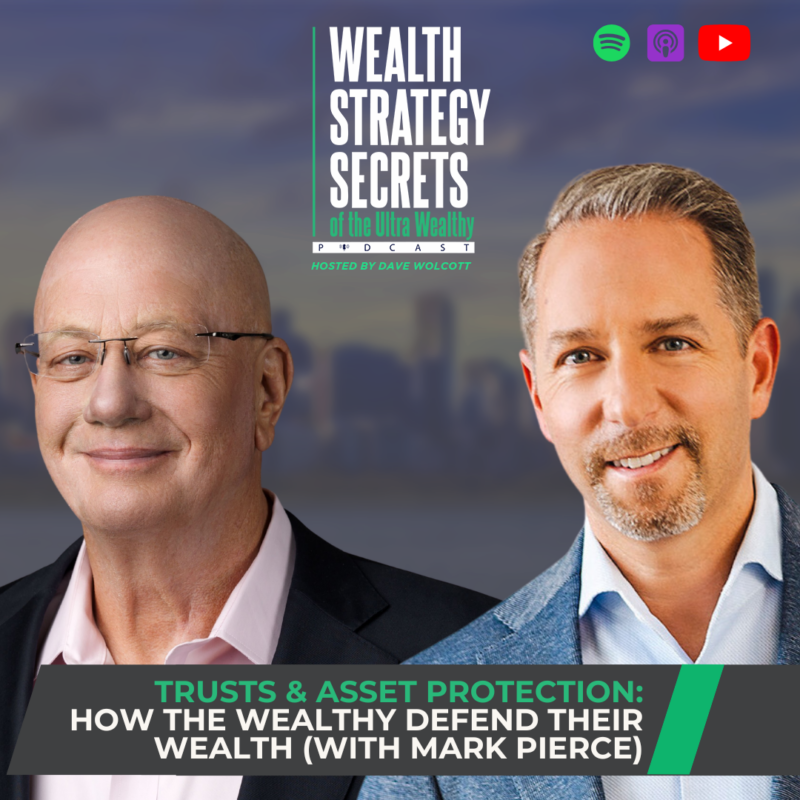
In this episode, Dave Wolcott sits down with trust attorney Mark Pierce , a wealth structuring expert with over 40 years of experience in asset protection, estate planning, trust law, and creditor defense. Together, Dave and Mark break down the fundamentals of trust structures, asset protection planning, Wyoming trust strategies, tax efficiency opportunities, and the biggest mistakes high-net-worth individuals make when attempting to safeguard their wealth.
Mark Pierce is a trust attorney with more than 40 years of experience in asset protection, estate planning, trust law, and advanced wealth structuring. Before advising entrepreneurs and high-net-worth families, Mark served as a bankruptcy trustee, giving him firsthand experience identifying weaknesses in legal structures and recovering assets for creditors. Today, he helps clients create asset protection strategies designed to withstand real-world legal challenges.
In This Episode
- Why asset protection is just as important as wealth creation—and how to build a true fortress around your assets
- The biggest trust and LLC mistakes wealthy individuals make that can leave their wealth exposed to creditors and lawsuits
- Why Wyoming has become one of the most powerful jurisdictions for asset protection, tax efficiency, and long-term wealth preservation
You start with the underlying structure to get your business right, and that helps your taxes more than anything else. And that provides a lot of asset protection. And then you put the trust on and then you get the mso. But every time you do that, it’s an incremental change. It doesn’t overwhelm you.
Welcome to the Wealth Strategy Secrets of the Ultra Wealthy podcast where we help entrepreneurs like you exponentially build wealth through passive income to live a life of freedom and prosperity. Are you tired of paying too much in taxes, gambling your future on the stock market, and want to learn about hidden strategies for making your money work for you? And now, your host, Dave Wolkop, serial entrepreneur and author of the best selling book, the Holistic Wealth Strategy.
How’s it going, everyone? And welcome back to Wealth Strategy Secrets of the Ultra Wealthy. Today’s guest is Mark Pierce, a trust attorney with more than 40 years of experience in asset protection, estate planning, and advanced wealth structuring. But what makes Mark uniquely qualified is that he’s worked from both sides of the battlefield. Before helping high net worth families and entrepreneurs protect their wealth, Mark spent years as a bankruptcy trustee going after assets, dismantling trust, and uncovering weaknesses in structures that people thought were protected. Today, Mark leverages that insider knowledge to help clients create strategic asset protection plans designed to actually hold up under legal pressure, not just look good on paper. In this episode, we unpack how trusts really work, the biggest mistakes wealthy people make when protecting assets, and why Wyoming has become one of the most powerful jurisdictions for wealth defense, and how to think about building a true fortress around your wealth.
Mark, welcome to the show.
Hey, thank you, Dave. I’m delighted to be here.
It’s a pleasure to have you on the show, Mark, and I think you’re going to bring a wealth of information to the audience today in a topic that is really understated as most people are really focused on generating wealth and not as much time playing defense on protecting their wealth. And one of the things I actually talked about in my book, the Holistic Wealth Strategy, I talked about the importance of this and I set the metaphor really, to kind of build a fortress around your wealth is one way to really think about it. But I think part of the problem, Mark, is really the lack of understanding, especially for high net worth individuals. Everyone has some kind of referral to, you know, an estate attorney or asset protection person, and maybe they’ve, they’ve kind of dabbled in this space, but they truly don’t really understand the structuring, how to set up the right structures, the right systems, you know, to truly create that fortress for themselves. So why don’t we begin and really talk about your unique background as it relates to, you know, asset protection, protection and estate planning and why you got into this field.
True wealth isn’t just about accumulation, it’s about creating systems that protect what you’ve built.
I got into it because I graduated from law school in 1980, and by night, or went to law school in 1980. And by 1983, Colorado, which is where I graduated from law school and then went to work from Denver for a large firm, ran into a financial collapse. And there wasn’t one bank that existed in Colorado in 1983 that managed to survive until 1990. As a result, they were looking for bankruptcy attorneys. They sort of looked around and said, well, look, your CPA should be able to figure this out, because I’ve been a CPA before I ever went to law school. And so I ended up in bankruptcy and litigated bankruptcy and dealt with bankruptcy for about 10 years. I was a panel trustee for the state of Colorado for the bankruptcy court in Colorado for almost 10 years. I administered 30 cases a month for a number of years.
I would say between 1,000 and 3,000 would be a pretty good guess as to what it was that we oversaw. I went through almost every aspect of a chapter 7 and a chapter 11 at that point in time, and I principally represented the bankruptcy trustee during that period of time. So I went after people and I went after their assets. After I got out of that, I then went into trust planning. And as a part of trust planning, most people go and said, well, you know, if I die, here’s what I want to have happen. Well, I think that if you’re worth a million or more, you probably should put more effort into it than. Than that, because you have these ups and downs in our financial system in the United States every 10 years. Like a friend of mine said, the banking system is like this every 10 years.
They open their mouth, blow out their brains, go to the government, get more money, and reinstitute themselves over that period of time. So just in the Last watch since 2008, we had a financial collapse. Then we had the COVID collapse. Those are significant events to people who made and lost a great deal of money. The way in which you protect that money is going to protect you from the standpoint of getting back into the game once those financial crises are over. And there was a gentleman by the name of T. Boone Pickens who was out of Texas years ago, and he had scratched his way up from nothing to become a very significant player in that area of business. Oil and gas exploration.
And he said, the thing that really resonated with me is you’ve got. You got to leave the table when you still got enough money to get back into the next game. And what most people do is they put themselves. They expose themselves to their creditors so that when you run into these financial collapses, you ended up into a court system which is slow, it’s methodical, and it’s devastating. For instance, like your homestead exemption in a state like Colorado is around $40,000. That’s what. What is that? A trailer house. Your car exemption is $2,500.
Your jewelry is about $2,500. Your bank accounts forget that they’re going to take all those things, and then they’ll go after your pension funds. And there are a variety of different ways in which they can get into those pension funds. So if you’re a businessman and you’re strategizing, you got to take that money off the table and protect it from your creditors. And to me, that has more of a foundational purpose than making sure your kids get what they’re supposed to have at their death. In fact, in many instances, that’s the easiest part of the planning. So that’s the background of how I got here. And I’ve been doing that level of planning now.
I’ve been practicing law for 45 years. I’ve been doing that level of planning specifically to help people and help businesses because I came from a small family business, and I’m very imbued over the last 50 years with how those work successfully and unsuccessfully. So it always seems to me that you put the protections in place to protect yourselves from unwanted creditors. But more importantly, it also puts mechanisms in place to protect you from family dynamics. And one of the dynamics you have are children. They get married, they get divorced. That spouse from outside the family then comes back and attempts to make a claim against familial assets, which in one instance, a friend of mine had given as a wedding gift to his son and his bride a significant portion of the company that they were involved in. And they were divorced 10 years later.
And they came back to me and said, well, how do we get that interest back from her? And the answer is pretty simple. You’re going to have to buy it. So you’re going to have to appraise it and buy it. And they didn’t want to do that. I said, well, then you’re going to have to give up 10 to 20% of your family wealth to an individual who happened to be married to your son for 10 years. So that’s the level of planning that you go through as well.
You’ve worked both sides of the battlefield. So what did you learn seeing trust fail in real court situations?
Oh, it’s really interesting. It’s the small things. And people always come in and they have a tendency to over complicate the best litigation. Comes in with very simple ideas. This person treated his trust, his or her trust, as simply a back pocket mechanism for them to stash money that they could use when and as they needed it. So there’s a really famous case where they were buying Bugatti’s, they were buying vacation homes, they were running their credit cards through the trust. There was no distinction between the Trust and the LLCs, or the corporations under the trust and their back pocket. And that’s the commingling aspect that you have.
So one of the purposes of these trusts is that we involve ourselves in getting that funding in it and we get that funding in place so that you got the appropriate corporate and LLC safeguards to make sure that you follow that flow of money. So that when an entity generates money, somebody doesn’t come in and just write a check to, say, one of their mistresses, which occurred in one case. And so he was left on the stand in front of a judge who’s been doing this for 30 years, going, you wrote a $30,000 check to your mistress, to this woman. What was her relationship? Well, I would just do not disclose it. Well, you have to disclose it because I’m here asking the question. If you don’t, I’m going to throw you in jail until you do. It’s called contempt. Oh, dear.
Well, I was having an affair with her and I didn’t want my wife to know. And you use trust fund money for that. Right. Well, that’s the end of the trust. You didn’t respect the trust, you didn’t respect your creditors, you didn’t respect the flow of money. So that, to me, is what happens more often than not is they confuse the trust with themselves.
Here is the cleaned transcript with the repeated words removed (such as the duplicate “separate,” “every year,” “the,” “and that,” and “right”), while keeping the rest of the dialogue entirely intact.
Yeah, interesting. Let’s talk a little bit about just trust 101. I think, you know, a lot of people maybe don’t have, you know, a thorough knowledge. Right? Of really how trusts work, you know, whether it’s irrevocable, revocable. I mean, let’s just talk about it from kind of a 101 perspective. And, you know, someone who needs, let’s say, minimal asset protection to, you know, a greater extent.
Yeah. Trust is a contract. There are three parties to the contract: there’s yourself, who’s the individual establishing the trust, is either called a grantor or settlor. And there’s the individual or the entity that acts as the trustee. And you see a lot of banks provide those services. In Wyoming, we have a qualified spendthrift trust which allows you to form your own private family trust company, act as the manager of that private trust company, and then act as the trustee on behalf of your own trust. It’s called a self-settled trust, which has to be recognized by statute. Doesn’t work outside of the statute.
Common law never provided for that. And then you have to have something in the trust. Typically what you put into the trust are your businesses, your LLC interests, your corporate interest, that sort of thing. And then underneath that umbrella, you operate that business structure like you would any other business structure. Then excess monies that you have within that business structure you peel off and put up into the trust. Then you invest the money in that trust, and you manage the money in that trust, and you do so for the benefit of your family. And then you make distributions out of that trust, and you separate the distribution function from all the other functions that you maintain in that trust. You provide for the investment analysis, you provide for the purchase and sale of securities, purchase and sale of real estate.
You run your companies just the same way that you did before. But once the money gets up into the trust, you can only take it out if you have an independent distribution committee acquiesce in the request for that distribution. And that’s typically run by my law firm, which is by law an independent entity, if you can figure that out. But that’s the way that you manage those distributions out of trust. So within the business context itself, you take your salary, you fund probably through an MSO, management service organization, all the insurances, all the governmental functions that you’ve got going on there, taxes and licenses and that. And then the excess monies goes up to the trust. That’s your piggy bank. You don’t touch that.
You only touch that in the event that you really need it for something, for instance, a child’s education. So you make a request into the trust, say, “Look, I’ve got a tuition payment that’s due, plus I need to send some money out to my son or my daughter because in a program they’ve got to have some money to eat and live.” And we make a distribution for that purpose. It’s all documented electronically so that if anybody ever comes in, it’s timestamped. You don’t spend, you know, three or four hours trying to verify if in fact that transfer and acquiescence occurred because it’s already timestamped. So that back and forth is how that trust works. So it sounds complicated, but it’s really not. The trust is just a separate entity, if you will, a contract that holds the assets for your benefit, and then you invest those assets in the way that you see fit.
And then at the end of the day, if you need something for an extraordinary circumstance, you take the money out.
So there can also be quite a range of different trusts. Whether it could be a domestic asset protection trust, an international asset protection trust, and then I’ve heard of all kinds of different trust structures where people are trying to, you know, drive tax efficiency through the trust. Some of those I think can be ambiguous, let’s just say, or have some gray area in there. How are people supposed to understand which trust is really best for them?
How you know, you can go onto my website, we’ve got hundreds of pages of descriptions on the types of trust that people have and what they need. Essentially, if you’re looking for asset protection and the transference of wealth legacy trust, you should get a qualified spendthrift trust, which has been characterized as a domestic asset protection trust as well. It’s what they call under the tax code a non-grantor trust. So you remove all those assets from your death estate. So you don’t have death taxes. You do that through a variety of mechanisms, valuation methodologies, and gift tax exemption amounts. And you get them outside of your estate so that you don’t have to worry about that. Because we’ve had estate taxation and then we’ve not had estate taxation in the United States.
I think it’s five or six different times in the last 120 years. And you know, they’re putting together proposals as to how they might re-implement that in the event that the political situation doesn’t right itself from the standpoint of the amount of money it’s spending. You know, what are we at, 40 trillion in debt? Something like that. And it’s jumped up from 10 trillion in the last 10 or 15 years. So it seems to me that they’re looking for additional sources of income. So I think that sort of estate planning really, really makes a difference for you. But you need an irrevocable trust for that purpose. That means you can’t revoke it.
Most people focus on growth. The wealthy focus on growth and protection.
If you’ve ever wondered how the wealthy use energy investments to reduce their tax bill while generating cash flow, we just answered every question on camera. Go to pantheoninvest.com/energy to find out.
But there are—and I sat down with a friend of mine who called me, who worked at the trust department for a large regional bank in the Northwest, and he asked me, “We have an irrevocable trust. What are typically the different ways in which you can get around that irrevocability?” And I said, “Well, I can think of 14 off the top of my head. Would you like to start at the top with the easiest things?” So irrevocable to you, “you can’t get out of it, you’re stuck,” is completely different from my understanding of irrevocability. So we can use accounting, we can put it over into different accounts, we can establish non-charitable specific purpose trusts for some of your charitable contacts. There are a lot of different ways that you can get money out of that trust without the necessity of getting rid of the trust. And if the trust purpose is stated in the trust document and that purpose has been met, we can dissolve the trust.
Easy enough.
Yeah. So how should people be thinking about, you know, why? Right? Because this creates a significant amount of complexity, a whole new layer that they need to understand, they need to manage and everything. So you talked about the why before. If someone has at least a million in assets that you’d want to have some protection, right? That’s pretty obvious. But give us some other really top reasons as to why someone would want to set up a structure like this.
I had a client of mine who was based out of New Jersey and they have, I think it’s a 14% state income tax, and he was running a very successful business and I won’t get into the particular industry. So we set up an asset protection trust in Wyoming, qualified spendthrift trust in Wyoming and domiciled it there, opened the estate accounts in Wyoming and his office paid a booking commission to that entity. From the standpoint of the services that he was rendering at that point in time, he ended up putting the first year that he was in there with, I think it was a 10% booking commission. Put a million dollars into the Wyoming trust. That million dollars did not pay New Jersey tax because it’s not domiciled in New Jersey and it’s a separate tax entity. So he paid no state tax. Whereas if he stayed in New Jersey, that paid $140,000. So you take that year to year to year and compound it, what’s that going to be worth in 10 years? Substantial sum of money.
Yeah.
So that was one of the reasons that he used. And it was easy enough for him to do because he understood the complexity. He took the time to read the sheets, to talk to me. And like I tell most of my clients, it’s going to take you a year to get this down. Okay? And then once you get it down, the second year is going to be easier. By the third year, you won’t be calling me.
Right. There’s a learning curve.
There is a learning curve, you know, and the nomenclature is different. You haven’t heard of it. But once you begin to work with it, it becomes really second nature to you because it flows and it makes sense. You’re talking to your accountant every year. You’re talking to your attorney. Like I tell people, they said, you know, you got rich. If you’re going to keep it, you’re going to have to learn how to act like you’re rich. And so that’s the methodology that you approach these things with, is that it’s just something more that I need to know.
Right. So the second reason would be driving tax efficiency within your structure. So one, asset protection, two, tax efficiency. And then, yeah, why don’t we talk about estate planning with reference to taxes as well?
You know, estate planning. I had a client that came in and he had 30 different properties, and he had them spread out with different entities, but he hadn’t titled them correctly. So we got that all corrected. So then we sat down, we said, “Okay, look, what’s the best way to implement the management of these 30 different properties that you have?” We put together a management services organization for him so that he could get life insurance for himself, develop a pension plan, have a systematic approach to paying all of the taxes that were due underneath those organizations, and he ended up paying a max tax rate of 21% versus 36%. I’ve got a friend of mine that puts these MSOs together worked out really well for him. So the cost, the legal cost and expense that first year was offset in the first couple months.
So he got that. Plus he was able to put together a group that could manage his businesses more efficiently than he had been doing himself. So that was something that worked out really well for him. And then when his son and his daughter came into this organization, he was able to begin to educate them as, “How does this thing work? Why does this MSO fit? How does that work with the trust? How do these various LLCs work? How do we plan for acquisitions in real estate?” So the acquisition, the development of real estate projects and the purchase of apartment buildings and that sort of thing became very easy for them because they understood it in the context of their family business. And it also allowed those kids to get slowly into that business and acclimate themselves to what was going on. So when it came down to the legacy planning, when they all sat down as a family, that’s easy.
Yeah. Why do you prefer Wyoming as a jurisdiction of choice?
A client of mine that was out of Atlanta said, “I’ve got to come and I’ve got to visit you before I sign the contract and elect to do this.” So he came from Atlanta on Monday and he flew to Minneapolis. He got caught in a snowstorm. He finally got to Billings, Montana, Wednesday morning. It took him a day to drive down to Sheridan. We spent about two hours together, had lunch, met the banker, and he left. And he got home on Saturday morning. And I said, “The reason you do that is because you can’t get to Wyoming from anywhere.”
That’s the principal reason. The second reason you do it for the laws are really benign for debtor-creditor relationships. So what happens is in a lot of states, if you owe somebody money, all the laws are in favor of the creditors. They had all the money. The banks put together the entire system. So when I initially got involved in Wyoming, I had read an article on The Economist that said, “Wyoming is the new offshore trust jurisdiction.” And I said, “Why is that?” And the guy who wrote the article literally lived about three miles from where I lived in northern Wyoming, just out in the middle of nowhere. So I went down and knocked on his gate and I talked to him, and I was introduced to the Wyoming Estate Political Action Committee through that.
This was a consortium of banks. Okay, because the banks are the ones who drive this sorts of things. Consortium of banks, attorneys, accountants, and legislators. So we had insight on the legislature as well, and they drove the statutory implementation in Wyoming so that you could get very favorable laws for debtors. And the reason the banks gave that up is because they’ll make more money on the trust side and the management of the money side than they ever made on lending money to businesses and going after bad debts or collecting those bad debts. Because I asked the bankers at one time, out of all the bad debts that you have, what percentage of your loans go bad monetarily and number wise, and what do you collect and what do you pay to get there? And it’s almost a zero-sum game a lot of times, because they do it because they think that they have to do it, but it doesn’t really make them much money doing it. So Wyoming implemented this system beginning about—this is back in the late 80s with the LLC. The LLC came in and Wyoming has the most debtor-friendly limited liability statutes in the United States.
So you started with that and then they evolved into the Asset Protection Trust. So one of the things that a lot of attorneys bring up is that Wyoming has a two and a four-year period for statute of limitations on fraudulent transfers. As a misnomer, they’re really not fraudulent transfers, they’re voidable preferences. So you prefer one creditor over another. That bankruptcy comes and they pull it back. That’s not fraud, that’s just something that goes on in the normal course of business. So these voidable preferences. Wyoming said if you put money into a trust, those creditors given this particular statute have four months to object to that.
Otherwise they lose their claims, they lose their abilities. So that’s a four-month statute of limitations from the time that you form the trust, put the assets in, before the creditors can bring an action to set aside the transfer. It’s not enough time, so it allows you in. Second thing is, Wyoming has a dedicated chancery court. I had a client of mine the other day who was looking at executing a contract. He said, “Well, do you have any law on this particular proposition?” And I said, “No.” He says, “Well, I’d like to see some law.” I said, “So would everyone else.”
The problem is the Chancery Court, when you file a suit there, seals all the documents. You don’t know what went on in that court or what went on with the litigation with it. But then they appointed the Chancery Court judge who actually knows what they’re doing. They’re very well educated and have a great deal of experience both in trust and LLC law. So I’ve litigated a couple of issues in front of them and found it just to be very enlightening to be engaged in a conversation with a judge instead of making a presentation of sides on a judge. So it’s more of a conversation now. It’s still a legal process, but it’s more of a conversation. And the conversation is pretty quick because you got three knowledgeable parties in there and if you don’t, the one who’s not knowledgeable is going to get flattened almost every time.
So it comes out generally in favor of the people in Wyoming. So if you make these transfers, you domicile your assets in Wyoming, somebody comes in with a judgment, say from Florida, Florida camp comes in, they want to enforce that judgment in Wyoming. Wyoming goes full faith and credit of the Constitution. You know, we’re bound by the Constitution, so your judgment is good. However, the collection process is endemic to Wyoming, so Wyoming’s laws apply to that. And there’s a famous case that came out of South Dakota on this called Cleopatra. It involved a very wealthy young woman who was a trust fund kid who got married and then needed to pay child support in South Dakota. Child support doesn’t get into these trusts.
So the Californians came to South Dakota, wanted to get a judgment enforced against that trust. And the court in South Dakota said, “No, you can’t do that.” And it cited all the U.S. federal cases as to why that can’t be. So you separate the judgment itself from the enforcement of the judgment. So if you come into Wyoming to enforce against Wyoming assets, you have to meet Wyoming collection law and guess where that goes. You got a four-month statute of limitations. You didn’t assert your rights and your remedies during that period of time. And guess what? In Wyoming, we don’t allow you to collect for that.
So that’s what happens. It’s basically another bite at the apple. And I think that in many instances gets people to settle.
Yeah, got it. And when would clients want to look to some type of offshore type jurisdiction? Does that make sense for some people?
It does. We just recently had a husband and a wife who came to us and they had an L1 and L2 visa. They had made an application for a green card, but we had them suspend that application so that—they had acquired a number of assets offshore. So there was absolutely no reason to subject those assets to U.S. taxation issues. So we have formed a couple of trusts out in the Cook Islands, which we have a relationship with on the Cook Islands that domesticated those assets in the islands before those individuals came to the United States. So that’s when we use the offshore trust. And I think that’s when it’s the most effective.
Now, one of the issues you have with offshore trusts in the United States is that they’re not looked on very favorably by the courts. But then again, you usually find people who are establishing offshore trusts outside of the Caribbean who are doing it for nefarious purposes. And there’s a very famous case where some people had gotten a judgment against them, I believe it was by the Commodity Futures Trading Commission for something they’d done—basically a Ponzi scheme where they’d spirited off with about $60 million. They were trying to convince the judge that, yeah, they trusted the $60 million to an individual in the Cook Islands, which is 17,000 people, just basically a sand spit. And you’ve never been there, you’ve never met them, and you turned over $60 million to them. “Yeah. Huh? That’s right, we did.” Now, that’s kind of incredulous, right? Yeah.
I mean, these are the people who sit there and negotiate a cup of coffee with you. So they’re not giving somebody they don’t know $60 million. So I think people have a tendency to dash offshore when they’re in a lot of trouble thinking it’s going to save them. Even in that particular instance, it didn’t, because the judge in the United States kept throwing them in jail for six-month periods of time because they’re in contempt of court. And guess what? The money finally showed up in a settlement. So you got to be very careful. Now, if you’re doing business on an international scale and you want to use offshore trusts, there are a lot of different jurisdictions in the Caribbean that can provide you a better result.
That’s interesting. That’s very seldom. And I know a lot of doctors established these offshore trusts back in the ’80s and ’90s, and now that they’re retiring, they’d like to get that money back. And particularly because the trustee said, “You just don’t have enough money in these trusts anymore. You’ve only got five to $10 million in here. We’d like to push it back to you.” So we put together the decanting. You just basically, you know, like wine, you decant it from one bottle to another. We put together the decanting into a local trust.
Yeah, that’s interesting. So, Mark, I think a lot of people are thinking, “Okay, now you’ve made the case for asset protection. I likely may have some holes in my structure. Maybe I need to kind of button this up or what I have right now isn’t really good.” But again, people can come from this perspective of you don’t know what you don’t know. So how could listeners really understand how to vet the proper attorney to select? What are some of the great questions that they can ask in determining who’s the right partner for them?
Right. On our website, I’ve detailed that. You look for somebody—my own view is you look for somebody who’s got an accounting background, because most of this comes back to accounting. Then you look at somebody who’s got a debtor-creditor background, both sides of the aisle, and then you find somebody who’s actually litigated those cases in bankruptcy court, and then you find somebody who’s actually litigated those cases in tax court. And then you go to somebody who’s got 20 years or more experience, because that’s what it takes. And those are the people you want to deal with. And I’ve kept running into a couple of the guys who sell a lot of these trusts who get so incredibly complicated with it and try to parse out such small details. You look at them and say, “You’ve made or lost the case a long time before that. You don’t think that your issue is going to hinge on that most of the time, do you?” “Oh, yes, we do.” Well, that’s because that’s what they’re selling. So get somebody who’s been on both sides of the aisle.
Yeah, I think it can be challenging. It’s like, you know, if you go try to buy a TV these days, right? I mean, you’ve got 8 million things, right? It’s the 4K, it’s the Dolby sound, right? You can buy so much capability, but it may not necessarily be what you actually need and can create additional complexity that’s just unnecessary.
Yeah. You know, don’t oversell them. You know, you get in there and you start with something and you get people used to it and then you say, “Okay, we can tack some things on.” It’s not that expensive. You can do some things that’ll make sense to you. Unless I use it, you start with the underlying structure to get your business right. And that helps your taxes more than anything else. And that provides a lot of asset protection. And then you put the trust on and then you get the MSO. But every time you do that, it’s an incremental change. It doesn’t overwhelm you.
Yeah. And I love that you have that tax background. You know, we talk about tax strategy a lot. It’s so important, I think, in this structure, you know, as you put that together, to have that knowledge as well and not just be coming from a legal perspective.
Exactly right. I mean, you know, if you could save 10% on your taxes, what does that make for you over 40 years?
Yeah, it’s massive.
Yeah.
Mark, let’s do some rapid-fire questions. All right, so first one: what is the biggest mistake wealthy people make?
Well, it’s what they call the Gatsby problem. It always gets better, it never gets worse. So they fail to plan for the downside. Yeah, like a friend of mine said, “I knew I was in trouble when I hid my jeep one night and the collection agency still found it.” This is Paul. “What did you do?” He said, “I tried to hide. I couldn’t hide from these people.” So he had to file bankruptcy. And he said he went from making over a million five a year to having nothing and having to rebuild everything. So the thing is start—and I tell people, you know, I can just tell when a 35-year-old comes in and puts these things together, that individual is going to be successful. They are planning for the worst, hoping for the best, maintaining that sense of realism.
What’s the most overrated strategy?
I think the most overrated strategy is offshore trusts. I think that that has a particular paradigm that goes into place for people doing particular types of businesses. And I’ve seen people come in with real estate holdings in the United States saying, “I’m going to put it in an offshore trust. That’ll be fine.” Like, yep, but you can’t move the real estate. You’re in Kansas. That judge is going to say, “You’ve got a Cook Islands trust. I don’t really care. I’m going to take that real estate and apply it to that debt.” And they can do that. So you know, they get oversold these things that don’t necessarily work on what it is that they’re doing, but they believe that because of the promotion that they’ve seen online that these things can save them.
Most underrated strategy?
Taking your movable assets like cash and stock accounts and just moving them into an LLC that you base in Wyoming. And you can either just keep the LLC there and organize it from there, or you can put it into an asset protection trust even better, so that you can funnel the money up to the asset protection trust and maintain it in Wyoming. Because people cannot get to those trust schemes. So they come into the LLC and they said, “We’re going to enforce our debt against that.” And the judge says, “Great, we’ve got one mechanism for doing that. If and when they ever make a transfer out of that LLC, you can have it.” And then they never make the transfer and we allow indirect transfers. So if you put your money into an LLC and you tell the LLC, “Hey, pay my mortgage bill, would you please?” The LLC pays that bill as a part of your compensation and the creditor comes back, says, “Wait, there was a distribution out.” Wyoming says, “Yeah, but those don’t count. That was an indirect distribution.”
What’s the biggest red flag when reviewing a client’s structure?
Flow of money. You know, just treating everything like it’s one big pot and then trying to take money out of that pot. You know, an ex-wife comes in and needs money, so the payment goes out to the court from one of the LLCs or from the trust. They just don’t respect the parameters of that. So they need to get that in place with their CPA and their attorney at that point.
Mark, if you could give just one piece of advice to the audience about how they could protect their wealth, what would it be?
Oh, the first strategy: get an LLC, put it under the trust paradigm, and study the text that we’ve got on our website. It’s there for your benefit. It’s built for small business.
Yeah. Awesome. Really appreciate your wisdom and insights today, Mark. It’s been really powerful, and I definitely urge the audience to really consider this. If you do not have a trust structure, an asset protection structure in place, put it on your goal plan to get it done this year. It does take some work, and I’m glad that you spelled it out because that’s what it was for me—about a year to get it in place. But that learning curve does grow once you kind of get used to how it should be structured and everything. So if people want to check out your website or learn more about engaging with you, what is the best place for them?
Yeah, go to our website. It’s wyomingtrustattorney.com and you can book an appointment. We can talk. We can go over what it is that you need. It’s pretty painless. Most people get done and say, “Well, you know, I learned a lot. It was really worth it.”
Excellent. Well, thank you so much for your time, Mark. Really appreciate it.
Thanks, Dave. Appreciate you having me on.
Thanks for listening to this episode of Wealth Strategy Secrets. If you’d like to get a free copy of the book, go to holisticwealthstrategy.com. That’s holisticwealthstrategy.com. If you’d like to learn more about upcoming opportunities at Pantheon, please visit pantheoninvest.com. That’s pantheoninvest.com.